Removing scaling in chiller tubes at passenger cruise vessel
A passenger cruise vessel faced severe scale deposits in their chiller condenser tubes. Learn more about how Goodway® equipment was used to solve this challenge.
The project and challenge
A cruise ship operating in warm Caribbean waters began experiencing a steady deterioration in chiller performance, a critical concern for a vessel where passenger comfort depends on reliable, continuous cooling.
The signs were unmistakable: elevated discharge pressures ranging from 9.8 to 10 bar, compressor surge events indicating significant condenser restriction, and a Performance Index (PI) that had dropped as low as 0.70, well below acceptable operating thresholds. With seawater inlet temperatures already climbing toward 30°C, restoring condenser efficiency was essential to maintain effective heat rejection capacity, stabilize compressor operation, and reduce electrical draw.
These conditions pointed to a single root cause: heavy mineral scale buildup inside the condenser tubes. Scale deposits act as an insulating barrier, restricting heat transfer, raising discharge pressures, and driving the compressor toward surge. Left unaddressed, this kind of fouling accelerates mechanical wear, increases energy consumption, and risks unplanned equipment failure consequences that no vessel can afford at sea.
The solution
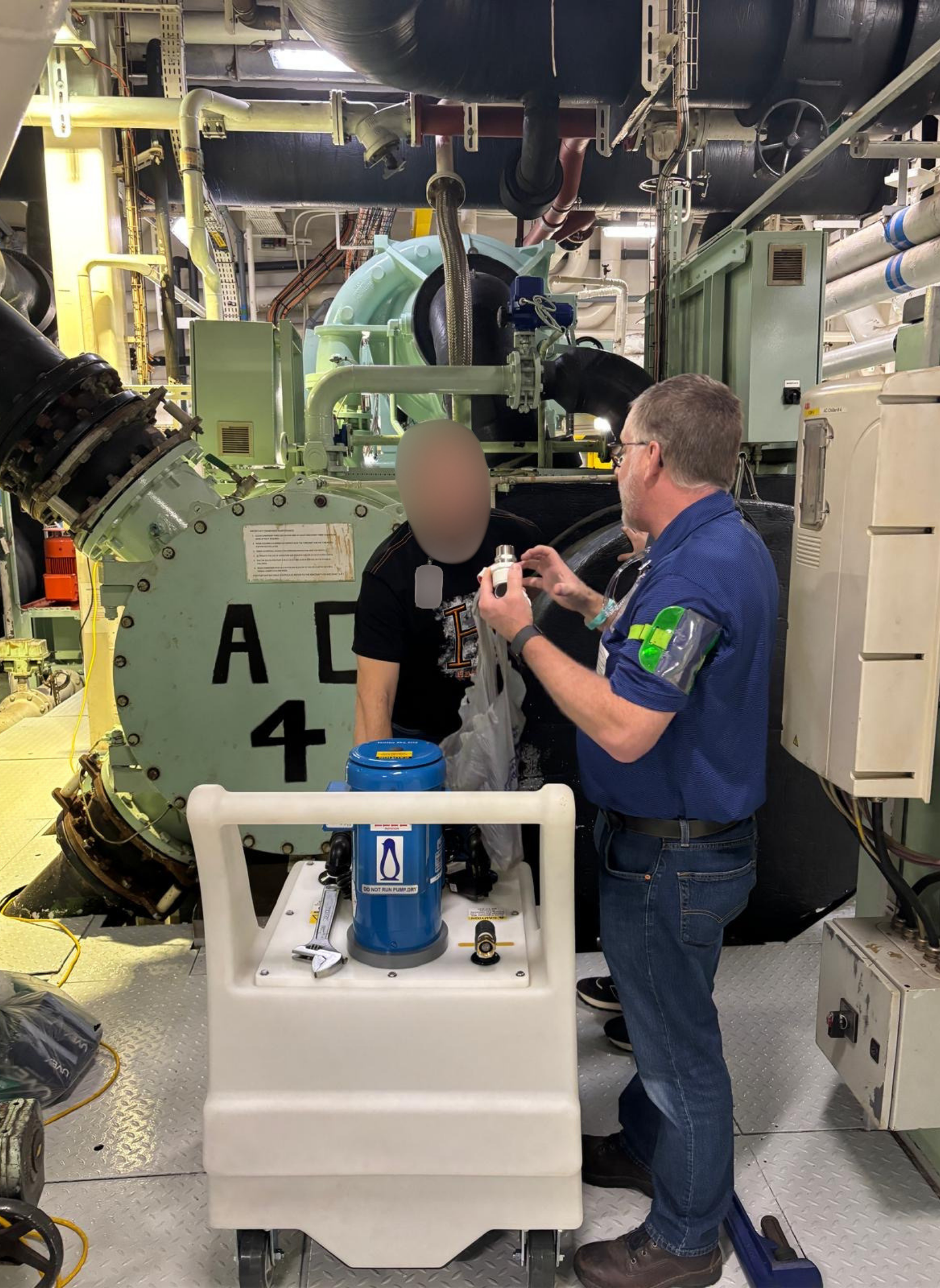
A chemical descaling procedure was performed using the Goodway® GDS-400 (clean-in-place) pump system and ScaleBreak. The ScaleBreak chemical was circulated directly through the condenser tubes, dissolving and flushing out heavy mineral deposits, including significant loosened debris, without mechanical disassembly. The process restored full contact of the tube surface with the fluid and heat-transfer efficiency while minimizing vessel downtime and labor.
Condenser tubes were visibly clean upon completion. With seawater inlet temperatures already climbing toward 30°C, restoring condenser efficiency was essential to allow the system to manage thermal load effectively, stabilize compressor operation, and reduce electrical draw across the fleet.
The result
The impact was immediate and measurable. Following the descaling procedure, the Fleet Ventilation Officer confirmed: “The cleaning resulted in eliminating the compressor surge, reduced discharge pressure, and restored system stability.”
The data
- Performance Index (PI) recovered from 0.70 to 0.98–1.0 — one chiller achieved a PI of 1.0 at 105% load
- Discharge pressure dropped from 9.8–10 bar to 9.2–9.4 bar
- Compressor surge was eliminated
- Electrical consumption dropped by 15–20 amps per chiller at full load
- Performance gains held even as seawater temperatures rose from 26°C to nearly 30°C
Notably, these results were achieved even with one chiller identified as slightly undercharged on refrigerant, confirming that condenser fouling, not refrigerant condition, had been the primary driver of performance loss. Further optimization of refrigerant charge is expected to deliver additional gains.
In high-seawater-temperature environments, condenser efficiency becomes increasingly critical because the refrigeration system has less temperature differential available for heat rejection. Routine chemical descaling is a proven, low-disruption maintenance strategy for improving chiller reliability, reducing energy consumption, and lowering operating costs across large cruise fleets.
Fleet-wide adoption
The success of the project has led to broader adoption of the descaling program, with 15 of the company’s cruise vessels implementing the GDS-400 and ScaleBreak® platform for condenser cleaning and chiller performance restoration.
(Please note: this project was carried out by Goodway® Technologies in the United States. Goodway Benelux, it’s European distributor has this project on their website as a case study, to share among it’s maritime and offshore customers.)